08-10-2025: 3 Small Habits That Make a Big Difference in How You Feel
Most people already know the basics of good health. The hard part is actually doing them consistently — especially when life gets busy.
The good news? As Dr. Bruce Lipton teaches, our bodies are constantly regenerating or degenerating based on the signals we give them. That means the same small, daily choices that cause wear and tear can also rebuild health and energy when we reverse them.
Here are three simple habits that can help your body repair itself — especially your adrenal glands, which are key to your energy, stress response, and overall resilience.
1. Eat in a steady rhythm
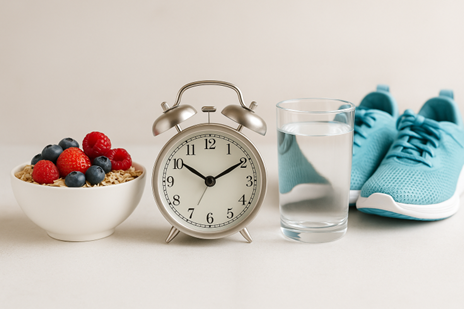
Eat four times a day, about 4 hours apart, with 12 hours between your first and last meal.
A sample schedule:
- Breakfast at 6:00 a.m.
- Lunch at 10:00 a.m.
- Snack at 2:00 p.m.
- Dinner at 6:00 p.m.
This pattern gives your body predictable fuel and helps balance stress hormones.
2. Rest and restore overnight
Aim to be asleep by 10:00 p.m. and up around 6:00 a.m. Your adrenal glands recharge best during the hours before midnight, so earlier bedtime isn’t just an old-fashioned idea — it’s biology.
3. Move every half hour
If you’re sitting for work or leisure, get up and move for the last 5 minutes of every 30-minute block.
A quick stretch, a walk to refill your water, or a few deep breaths can reset your circulation and boost your energy.
Small changes can rebuild your foundation. If you’re not currently a client and would like to get back on track, simply send an email and I’ll share the next steps.
07-01-2025 “Who Should Pay? The Real Cost of Health”
“This updated reflection builds on a past post about the personal and societal cost of health choices.”
When a client came to see me after a pre-diabetes diagnosis, his wife hoped he would take charge of his health. His doctors had given him colorful charts outlining lifestyle changes—but he wasn’t willing to change. Not long after, he developed full-blown diabetes… then Alzheimer’s, a condition now recognized by some as “Type 3 diabetes.”
Sadly, this pattern is all too familiar. Many people assume the medical community can fix what poor lifestyle choices have caused. They want medications, replacements, and procedures—but often without addressing the root cause: themselves.
Think of it like a car: the dashboard lights up to warn of problems. Instead of fixing the engine, we tape over the lights. Eventually, the car breaks down. That’s what happens when we suppress symptoms without correcting habits.
Many patients are never told the true cost of not changing. Worse, the financial burden of chronic illness is passed on to future generations through insurance and government programs. Our grandchildren may end up footing the bill.
When I started nursing 50 years ago, patients without insurance were taught how to eat well. Today, even with insurance, that kind of guidance is rare.
You Have a Right to Ask:
Before agreeing to a procedure, test, or treatment:
– What is the cost?
– Who pays for it?
– Will it help—and for how long?
– What are the risks or side effects?
Even when asking these questions is hard, it’s your responsibility—and your right—to be informed.
In Summary:
The cost of ignoring your health is high—for you, your family, and society. Healthy habits are your best investment, and you are your first line of defense. The good news? You get to decide every day how you want to feel tomorrow.
Stay tuned—I’ll be sharing routine tips to help you stay well and take charge.
For your health,
Helen
05-11-2025- Rooted and Growing

Reflections on a Life in Holistic Health—and What Still Matters Most
🌿 Healing Begins With What We Already Know
Over the years, I’ve found that most people already have an inner sense of what would help them feel better. They know they need better food, more rest, less stress, or to speak more kindly to themselves—but they often need someone to walk alongside them, offer a plan, and remind them that small steps can still lead to healing.
The good news is this: the body is remarkably designed to regenerate. When we provide clean nutrition, supportive supplements, and begin replacing harmful beliefs with hopeful, truthful ones—health often begins to return.
🌱 Boundaries Are a Form of Wisdom
In the early years, I often said “yes” more than I should have. I wanted to help, to serve, to please. It took time to learn that healthy boundaries are not barriers—they are bridges to longevity and clarity.
Without a mentor, I didn’t have anyone to show me how to balance giving with guarding energy. I’ve come to understand that strength doesn’t come from doing it all—it comes from doing what’s truly aligned with your calling.
🍎 Some Things Still Hold True
Food is still the foundation. Herbs are food. Supplements are tools. Movement, breathing, gratitude, quiet, and rhythm still matter—maybe more now than ever.
Even as the world becomes more complex, I continue to trust in the timeless ways the body speaks and the gentle healing that comes through steady effort, nourishing choices, and a clear purpose.
🌻 A Work That Grows With You
I’m still learning. I’m learning how to preserve my energy and serve with joy. I’m learning how to build profit with integrity and reduce my workload without reducing the value I offer.
If you are just starting your journey in the healing professions, I hope this encourages you: you don’t need to have it all figured out. You simply need to keep listening—to your clients, to your instincts, and to what brings peace.
The work will shape you as much as you shape the work. Let it grow you.
💛 A Word to My Clients
To those I’ve worked with over the years—whether we’ve walked together for months or decades—thank you. You’ve been my teachers as much as I’ve been yours. You’ve shown me what courage, patience, and healing look like in real life.
To those considering this path of wellness: know that it’s not about perfection. It’s about coming back to what matters—good food, meaningful rhythms, the right support, and a deep belief that your body was made to heal. I’m here to walk with you, wherever you are in that journey.
When I began this work, holistic health wasn’t widely understood or accepted. There weren’t roadmaps or mentors who had walked the exact path I felt called to. I simply followed what I believed to be true: that the body can heal, and that a well-lived life begins with nourishing the whole person—body, mind, and spirit.
I’ve been learning ever since.
04.11.2025 -Who Should Pay? The Real Cost of Health
When a client came to see me after a pre-diabetes diagnosis, his wife hoped he would take charge of his health. His doctors had given him colorful charts outlining lifestyle changes—but he wasn’t willing to change. Not long after, he developed full-blown diabetes… then Alzheimer’s, a condition now recognized by some as “Type 3 diabetes.”
Sadly, this pattern is all too familiar. Many people assume the medical community can fix what poor lifestyle choices have caused. They want medications, replacements, and procedures—but often without addressing the root cause: themselves.
Think of it like a car: the dashboard lights up to warn of problems. Instead of fixing the engine, we tape over the lights. Eventually, the car breaks down. That’s what happens when we suppress symptoms without correcting habits.
Many patients are never told the true cost of not changing. Worse, the financial burden of chronic illness is passed on to future generations through insurance and government programs. Our grandchildren may end up footing the bill.
When I started nursing 50 years ago, patients without insurance were taught how to eat well. Today, even with insurance, that kind of guidance is rare.
You Have a Right to Ask:
Before agreeing to a procedure, test, or treatment:
– What is the cost?
– Who pays for it?
– Will it help—and for how long?
– What are the risks or side effects?
Even when asking these questions is hard, it’s your responsibility—and your right—to be informed.
In Summary:
The cost of ignoring your health is high—for you, your family, and society. Healthy habits are your best investment, and you are your first line of defense. The good news? You get to decide every day how you want to feel tomorrow.
Stay tuned—I’ll be sharing routine tips to help you stay well and take charge.
For your health,
Helen

1-15-20 Accept Responsibility and Know Your Options

- Notice when we are doing an old unwanted, unproductive habit
- Determine what new habit we want to substitute for that old habit
- Practice the new habit until it becomes automatic
- “How do you want to be when we are done?”
- “What do you want?”
- “What resources do you want to connect with today?”
- “Remember you have all the resources you need for whatever comes your way.”
Habits and healing can be driven by attitudes. And attitudes can be changed with information as well as mind-body work.Recently, one of my clients who is also a health care practitioner, asked me how I explain what I do in 10 words or less. My answer was: I am here to help others find the cause of their symptoms and guide them to a point of regeneration. If you counted, that answer was 20 words. To make it 10 words, my answer would be: I listen, I give feedback, I support, I expect healing.
Be empowered to make good decisions! Consider making some New Year’s resolutions using the awareness you gain after taking this assessment. At Options, my goal is to assist you to reach a new level in your own healing process. I am not offering a bag of cures or a book of answers, but rather, a variety of options you can choose from when you determine what your personal goals are, and when you are ready and willing to achieve those goals. I will listen, I will give feedback, I will support, and I will expect healing along with you. Email me at options@mtco.com now!
Yours on the healing journey,
Helen
9-26-19 Make Writing Easy With Two Simple Exercises
I was helping my granddaughter with the papers in her school folder this past weekend. Two of the letters she was to learn to write and recognize were p and d. Both of these letters require a student to be able to recognize left and right directions.
Two Brain Gym® exercises that can be beneficial to help a student know their directions are Lazy 8 and Cross Crawl.

Lazy 8s are done by drawing an “8” that is lying on its side. The student starts the Lazy 8 in the center, drawing up to the left. Variations of this exercise include using the right, left and both hands together. Lazy 8s can be drawn in any sizes. The student may also use various writing utensils such as pens, crayons, colored pencils, paint, etc. Lazy 8s relax the muscles of the eyes, neck, and shoulders while focusing and improve eye-muscle coordination. Lazy 8s also help the student recognize symmetry and improves depth perception. The Lazy 8s or infinity symbol integrates the right and left visual fields, enabling the reader to cross the midline without interruption. Source: Alternative Health Care, Space Age Interpretations of Age-Old Truths, M. Press. 1994. pg. 143. http://www.options-center.com/pdf/helens%20book/sections/section_3.PDF

Cross Crawling gets both eyes working together and enhances coordination and spatial awareness. It improves vision and hearing as well as breathing and fitness. It activates the brain for crossing the visual, auditory, kinesthetic and tactile midline, improving left to right eye movements and binocular (both eyes together) vision.
Cross crawl also helps with such academic skills as spelling, writing, listening, reading, and comprehension by activating both brain hemispheres simultaneously and is potentially the best warm up for all skills which require crossing the midline.
Procedure: While sitting or standing, lift one leg and touch knee with opposite hand. Repeat with other leg and its opposite hand in rhythmic cadence, back and forth. Source: Alternative Health Care, Space Age Interpretations of Age-Old Truths, M. Press. 1994. pg. 141. http://www.options-center.com/pdf/helens%20book/sections/section_3.PDF
For your information, I would be happy to discuss with you these exercises and any other Brain Gym® exercises. My email address is options@mtco.com. My website is www.options-center.com.
Partnering with you to make learning easy and fun.
Yours on the journey,
Helen
9-12-2019 Empathy

This past week my left ear plugged up and I could not hear anything with it. I didn’t know what direction sound was coming from; didn’t know how loud I was talking; hard to hear others and I even thought it affected my vision!
Wow, did this give me empathy! I thought about others who have permanent hearing loss. I remembered how in nursing classes we would have exercises like keeping our arm in a sling all day so we would know what the patients felt like when their arms were in slings. I knew my handicap was temporary and appreciated others talking louder and giving me all kinds of advice of what to do and what their experiences were of getting their hearing back.
LET’s take a closer look at EMPATHY:
HOW IT CAN BE BLOCKED
- “The frontal lobe is the seat of higher human functions such as love, connection, empathy, creativity, initiative, autonomy and willpower. By reducing human self-consciousness, these [pharmaceutical] drugs may rob us of our spirituality, our very souls.” -Rachelle Robinett, “Your Brain on Herbs: Neurotransmitters and Nature’s Pharmaceuticals,”
- “Self-absorption in all its forms kills empathy, let alone compassion. When we focus on ourselves, our world contracts as our problems and preoccupations loom large. But when we focus on others, our world expands. Our own problems drift to the periphery of the mind and so seem smaller, and we increase our capacity for connection – or compassionate action.” – Daniel Goleman, Social Intelligence
SIMPLE WAYS TO IMPROVE EMPATHY
Use Open Heart, a Flower Essence available at Options Center. Open Heart is a blend of flower essences that help people to heal wounds that are keeping them from having an open, loving heart. This blend helps a person recognize and acknowledge their unresolved wounds from childhood and previous relationships. It helps them grieve their losses and open to new possibilities of love and connection. It also increases compassion, empathy and trust in relationships, where trust has been lost or damaged. It helps to heal people who have become “hard of heart,” resulting in a lack of empathy and compassion for others. A person with a closed heart becomes inflexible, rigid and judgmental and lacks joy, happiness and pleasure in their life.
Another way to improve empathy is to do Positive Points, a Brain Gym exercise which connects to our frontal lobe. Simply put your hand on your forehead and focus on your breath. We often do this automatically when we need to de-stress.
EMPATHY WITH CHILDREN

Alfred Adler, an Austrian psychotherapist and psychologist, emphasized empathy in relationships. Those of you who know me well, know that I love his work. Adler’s approach was to not argue with a client. He helped them see that the conflict was between their private logic and common sense. He used friendliness, warmth, caring, and empathy to win them over emotionally. A purely logical argument or the unveiling of mistakes would not have elicited core psychological change. Adler used encouragement rather than argument. He first built clients up and helped them make steps in a new direction before discussing their faults.
-From Adler and Socrates: Similarities and Differences by Henry T. Stein, Ph.D.
Now is the time of going back to school when children are being involved in many new experiences. Let’s us, as the adults in their lives, take this opportunity to be empathetic to them. I found some quotes and advice on empathy and wanted to share them. Many of them are Adler based.
Respond with empathy in a matter-of-fact manner using love and logic.
- When a child misbehaves or is disappointed, keep your empathy short, sweet, simple and repetitive. You might say something like: “This is so sad.” Or “wow, this is so hard but you’ll have to clean your room before you can find your ball to play.”
- Use natural & logical consequences that allow them to experience the actual result of their own behavior. If they intentionally break a toy, don’t replace it or have them earn the replacement money. -From Options Email Education Course, Part 10, Positive Parenting
Time Out vs. Time In:
Putting children in time-out deprives them of an opportunity to build skills that other types of discipline could focus on. When children concentrate on their horrible luck to have such a mean, unfair mom or dad, they miss out on an opportunity to build insight, empathy, and problem-solving skills. Setting clear limits while emphasizing collaboration, conversation, and respect gives kids a chance to practice being active, empathic decision makers who are empowered to figure things out on their own.
Next time the need for discipline arises, parents might consider a “time-in”: forging a loving connection, such as sitting with the child and talking or comforting. Some time to calm down can be extremely valuable for children, teaching them how to pause and reflect on their behavior. Especially for younger children, such reflection is created in relationship, not in isolation. And all of this will make parenting a whole lot more effective and rewarding in the long run.
– From No-Drama Discipline: The Whole-Brain Way to Calm the Chaos and Nurture Your Child’s Developing Mind by Daniel J. Siegel, M.D., and Bryson
Praise their efforts.
Children need to hear when they are on the right path. It takes a lot of energy and will to work through emotions. Give them feedback about their efforts when you see them trying to work through a difficult social or emotional situation, such as sharing a toy, showing empathy, or waiting their turn at the playground. It’s better to praise their efforts rather than the outcome. This gives them the message that the outcome is in their control and dependent on their hard work. “It’s hard to wait your turn when you want something really bad, but I saw how patiently you waited for your turn on the slide today. You were respectful to the other kids and it was really nice to see.”
-From “How Do You Teach a Child Emotional Regulation?” by Alexa Brett, Balance & Thrive, Brain & Sensory, Growing UP, March 14, 2015.
Encourage with empathy.
Sympathizing with another person seldom helps him; rather it conveys that life had been unfair to him. Understanding the situation and believing in this child’s ability to adjust to it is of much greater help to him.
Example: “I can understand how you feel (not sympathy, but empathy) but I’m sure you’ll be able to handle it.”
-From Some Words of Encouragement by Clint Reimer
Yours on the journey,
Helen
6-12-19 TFH Conference
EPIGENETICS:

As those of you know who do mind-body appointments with me, To keep my certifications current in both Brain Gym® and Touch for Health I attend specified courses. In April I had the opportunity to attend the “Touch for Health” international conference in Boise, Idaho. That is where my sister-in-law lives so my husband, Ed, and I made our annual visit at that time so I could visit with her and take re-certification classes.
After getting more information about the conference, I realized the first day would include a pre-conference about epigenetics, which intrigued me. I knew that epigenectics was how we turn on and off our genes and I wondered how I might apply that information to my health practice. During the pre-conference, I appreciated the explanations Dr. Bruce and Joan Dewe from New Zealand explaining the epigenetic process utilizing the Touch for Health principles to positively affect a person’s health. This in-depth epigenetics program was well worth my time personally and professionally.
I am excited to bring my certification techniques to my clients. Prior to the study of epigenetics the belief was that genes controlled the body. Epeigentics reveals that each individual has the power to turn on the beneficial genes and turn off the detrimental genes. “I am in control of my genes. My genes are not in control of me.” I have been using these techniques with clients ever since and have received positive results and feedback. Schedule an appointment for mind-body work if you’re curious how this might apply to you!
MEETING OLD FRIENDS AND TRYING NEW THINGS:

I was challenged with the idea of going to a conference where I virtually knew no one. Talk about taking myself out of my comfort zone!!! I also acquired a new skill… Uber rides, Uber solved the challenge of getting to and from the house where we were staying as well as our time at the hotel. I highly recommend using Uber when you travel.
I figured that I would know no one at this conference. It turned out that I reunited with an old friend, Bonnie Hershey, on the first day of the conference. (Bonnie and I had taken our Brain Gym In-Depth course in 1989). Other pluses: I was excited to meet in person, Colleen Gardner, who became in 1986 the first international faculty member for Brain Gym®. Other attendees and I enjoyed many long walks surrounded in the nature and beauty of springtime around the Green Belt, a stretch of the Boise River that was next to the conference hotel.
Wishing you a wonderful summer and longevity with quality health,
Helen
3/6/2019 – Go Backwards


Recently I attended my cousin’s funeral. This got me thinking about the memories we shared, the childhood times that we were at each other’s house, riding our bikes the ¼ mile to each other’s house, the years of being in the same grade and many of the same classes, riding on the same school bus, graduating together, double dating, getting married the same year more than 50 years ago, getting married in the same church which was now the church I was sitting in for his funeral. I listened to the things that were being said about him.
His death was very sudden and he probably didn’t have any time to tell others good bye or any last words. I wondered, if he would have had time, what he would have said. My mind drifted to what I would like to say to others. After a few days of pondering, today, here’s what I have to say to others, Go Backwards.
My suggestions are:
- First, find your passion, your mission.
Diane Rehm, best known as being an American public radio talk show host, said that it took her years, but she eventually created the job that was best for her and that she loved to do. She is in her 80’s and is still doing a job that she loves.
How could you create the job you love?If you were financially secure now and for the future, physically, emotionally and mentally well and you still wanted to work, what would motivate you to still work? What is your passion? What is your mission?
What would motivate you to get up and still work? - Get financially independent.
Go backwards. How much money do you need for retirement, get that taken care of as soon as possible. Let the rest fall into place. - Get physically well.
Go backwards. Get preventive tests. Find your weaknesses, your risks and correct them. For example, hair analysis can pick up problems up to 20 years before a medical diagnosis. - Stay mentally alert.
Get the blood tests to show tendency to Alzheimer’s, etc and correct your lifestyle using such things as epigenetics to turn off your bad genes and turn on your good genes. - Write your own obituary.
Go backwards. About 20 years ago, I read a book that suggested that you write your own obituary. It was one of the best exercises I have ever done. It gave me tremendous insight on how I wanted my life to be at the end of my life. I encourage you to do the same.
Starting with the end in mind and going backwards makes it easier to get there. The brain responds to what is programmed in. This can be beneficial or detrimental. If we program in the brain with what we want, the brain partners with the rest of us in meeting our goals, rather than losing focus or worse yet, sabotaging what we do want. When our brain, mind, heart and spirit are all united in common goals, it makes the process of accomplishing them much easier!
For your health,
Helen
12/12/18 – Screen Time can be Addictive

I recently read an article discussing how addictive screen time is for children and adults. This includes gaming, tablets, cell phones, computer screens, television and movies. Are we inadvertently creating addictions in our children? I am concerned for my grandchildren and the children of the world in how they are naively being programed for addictions via sugar and screen time.
The article sights resources sharing my concern. “Glowing screens are so powerful that the University of Washington has been using a virtual reality video game to help military burn victims with pain management during their treatments. Beneficially, when patients are immersed in the game they report reduced pain, all without the aid of actual narcotics. Consequently, this same power of screens acts like an addictive drug to our kids (2). “
Read the full article here.
The more we can educate ourselves of the risks to our children the more motivated we are to make positive changes to protect them.
For your health,
Helen
11/28/18 -Wise Christmas Spending on Children

I have recently been discussing with a couple who are grandparents and how to support their grandchildren to have a college fund started so that when the grandchildren are 18, the college fund will be sufficient for them. The couple was shocked at the amount of money that their grandchildren would possibly need even for public higher education. The discussion included how at Christmas time, they spend hundreds of dollars for their grandchildren’s Christmas gift. I offered the idea of buying one small toy for the child to unwrap and the rest of the money to go to the college fund.
This article offers 4 ways to gift for a college fund.
- US Savings Bonds
- Gift cards: Retail stores across the U.S. are selling plastic gift cards that link to college savings accounts. Offered by giftofcollege.com, an online registry for gifts to 529 plan accounts, friends and family can purchase the cards and give a tangible gift card for college savings.
- 529 websites: Some 529 plans allow college savers to create customized WebPages with pictures and information about themselves. Friends and family can then contribute directly to a recipient’s college savings account via the webpage.
- Cash or checks: It may not be cutting-edge, but giving a child cash or a check and earmarking it for college may still be a welcome gift. Nine out of 10 parents say higher education is one of the best gifts they ever received, according to the Fidelity survey.
Make wonderful holiday memories by getting the most for your money and invest wisely in your grandchildren’s future.

01/17/2018 – Stroke Brain Gym and Energy Work
I currently have the honor and privilege of assisting two people who have had strokes. We are using Brain Gym® and exercises that have a Feldenkrais basis. Both of them are feeling positive changes. They are getting some feeling in the affected limbs that they have not felt since before the stroke. Getting these kinds of results is part of what makes my work so rewarding!!!
You’ll be able to get an idea of what we do by reading the Brain Gym® articles on strokes from the Hearts at Play blog cited below.
• http://heartsatplay.com/?s=stroke
• http://heartsatplay.com/double-doodle-play-brings-emotional-harmony-following-a-stroke/
If you want some ideas how to protect your own brain health, I’ve included some links below which clients have shared with me.
• Here is a 4 minute CBS TV overview of SuperBrain Yoga. It is good for improving brain functioning and may be of benefit to all of us: https://www.youtube.com/watch?v=KSwhpF9iJSs&feature=youtu.be
• Here’s a 5 minute daily routine from Super Brain Yoga which combines Brain Gym®, Donna Eden’s energy exercises, tapping and yoga: https://www.youtube.com/watch?v=d8uDl0_T5QI
• Here’s an 11 ½ min extended version of Donna Eden’s official YouTube video teaching her energy exercises for overall health: https://www.youtube.com/watch?v=Di5Ua44iuXc
Find the routine/exercises that you like and will look forward doing. If you feel better after you are done, it’s probably right for you. Just a few minutes a day can change your attitude, mood, comprehension and focus.
Yours on the journey,
Helen
01/05/2018 – Monitor technology time for your child
Dear Friends,
Since the holiday gifts often bring new electronic technology into our families, I wanted to share my thoughts on what I think of as healthy use, backed by research studies, several online articles, and my work with Brain Gym®.
All children from birth into their twenties have brains that have not yet finished growing and developing. Because of that, technology overuse can negatively impact the health of their brains, their overall physical condition, and their social and emotional health.
Young children, especially, should be supervised with limited access to electronic technology like TV, computers, smartphones and gaming stations, particularly if they are preschool or early elementary age. Instead they should be spending most of their time in gross motor, fine motor and social activities. Ideally they should have daily outside time (even if just a few minutes) with exposure to sunshine, nature and fresh air, rather than sitting in isolation in front of a screen. The screen pixels confuse their brains and the type of light that these screens emit can interfere with sleep and the ability of the brain to calm itself . Screen time can also result in myopic eye development, causing a national trend towards more children needing eyeglasses for near-sightedness.
Tweens and teenagers are at the age when cell phones become part of their dress code. With that there arise physical and emotional/social risks. Physical harm can occur in several forms. Digital disabilities is a new name for repetitive stress injuries from technology that affect the neck, fingers and elbow. More serious physical harm can occur due to distraction when texting while walking (like walking into traffic), and phone use/texting while driving. Increased exposure to the head can even cause brain tumors. Emotional concerns can occur with social media criticism (online bullying and body shaming), with unwise sharing of revealing selfies and private information, and with access to unfiltered adult content like pornography. For our children, the idea of a “safe” zone is fragile when peer pressure is relentless.
Busy parents, social media and increased “screen time” can all negatively impact our youth. No matter their child’s age, parents should stay involved by building real-time face-to-face conversations into their family routine to counter the ever-growing effects of electronic technology. It is worth your time to read this whole article which includes both research and an action plan.
09/05/2017 – Avoid Toxin Overload
Be kind to yourself, others and [benefit too]!
Women are taught to believe, encouraged by the media and feel peer pressure to change their body’s image. Women need to start thinking for themselves, not be influenced by advertisements and peer pressure. Women and men put many chemicals on their bodies every day; women more than men.
The top 3 toxic professions are farmers, hair dressers and house cleaners.
What you CAN do:
1] Change to natural cleaning products.
2] Admire your nails in their natural state. Let them “breathe.”
3] Let your hair go natural.
According to © 2017 CureJoy Inc. in its article, “When Is The Right Time To Stop Coloring Your Hair” these are the signs that your hair is telling you that it is time to go natural and stop coloring your hair. The signs are 1] Your Roots Grow Faster Than Before, 2] Your Hair Is Brittle and Frizzy, 3] Your Scalp Gets Irritated and Itchy 4] Your Hair Is Thinning, 5] Your Hair Is Persistently Dyed In Lighter Shades-when it gets to your natural color, stop coloring.
Apart from these, persistent dyeing might be heavy on pocket every time you go to a salon. Putting a halt to the coloring process liberates you from not just the expenses, but also the guilt of having an unkempt look every time you see yourself in the mirror.